Weekly Market Commentary
Week in Review
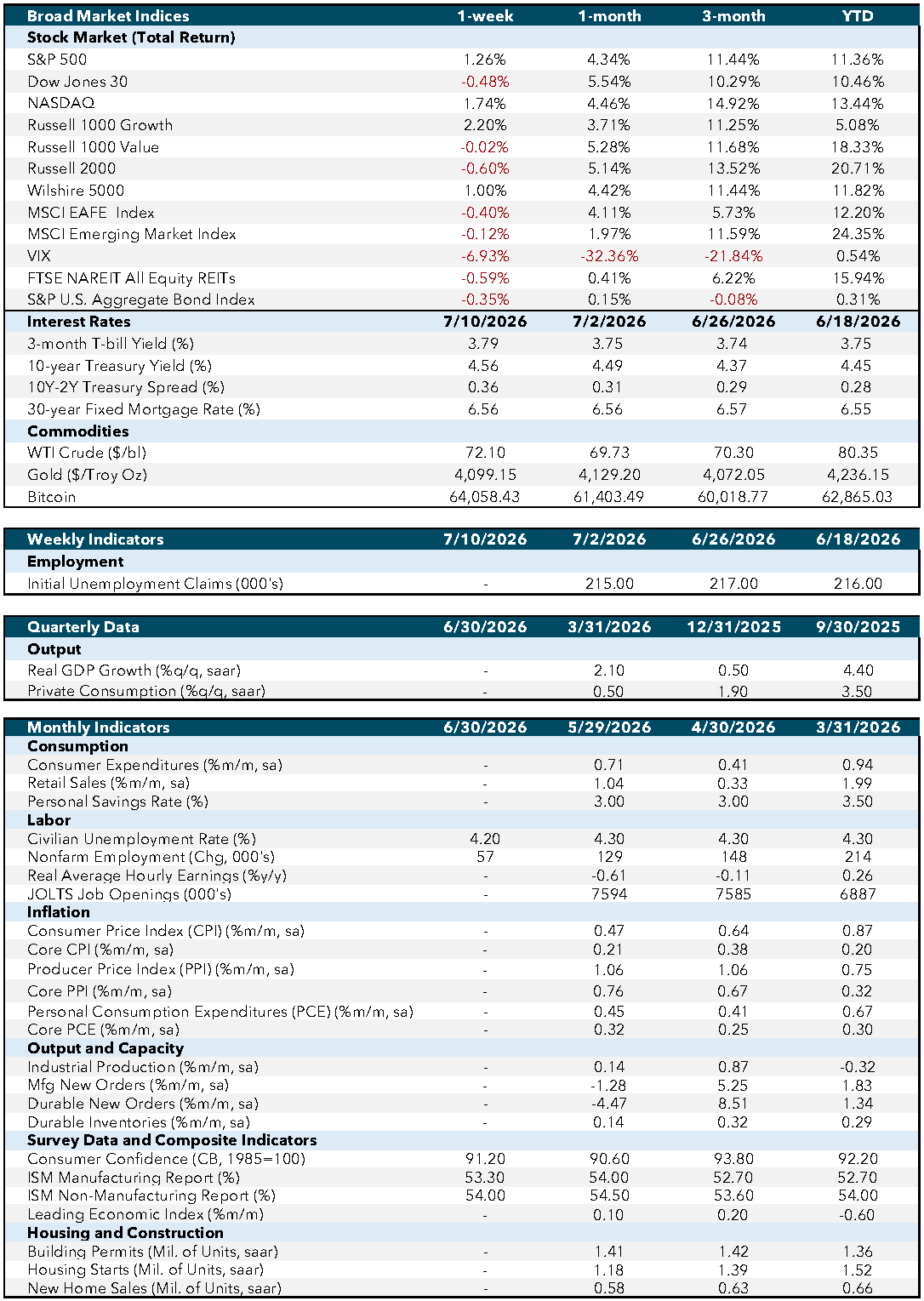
The week of July 6, 2026, was marked by several U.S. economic releases that pointed to continued economic resilience, while also showing pockets of moderation across services activity, housing, and energy inventories. Investors focused on service-sector data, labor market conditions, Treasury auctions, and Federal Reserve communications for additional insight into the broader economic backdrop.
Service-sector activity remained in expansion territory, although June readings came in slightly below expectations. The Services Purchasing Managers’ Index (PMI) registered 51.2 compared to expectations of 51.3, while the ISM Non-Manufacturing PMI came in at 54.0 versus expectations of 54.2. While both readings modestly missed consensus, levels above 50 continue to indicate expansion. Inflation pressures within the services sector remained notable, as the ISM Non-Manufacturing Prices Index decreased to 67.7, yet remained slightly above expectations of 67.5.
Other economic data was mixed. Initial jobless claims declined to 215,000, below expectations of 218,000, suggesting that labor market conditions remained relatively firm during the week. Existing home sales, however, came in below expectations at 4.09 million versus forecasts of 4.19 million, indicating continued softness in housing activity. Crude oil inventories also increased by 2.998 million barrels, compared to expectations for a 1.900-million-barrel drawdown.
The Federal Reserve remained in focus through the release of the Federal Open Market Committee (FOMC) Meeting Minutes and the Fed Monetary Policy Report. Treasury market activity included a 10-Year Note auction at 4.580% and a 30-Year Bond auction at 5.058%. Overall, the week’s data supported the view that the U.S. economy remains stable, though persistent services inflation and uneven housing data continue to warrant monitoring.
Economic and Capital Markets Dashboard
Week Ahead
The upcoming week should provide investors with a clearer picture of whether the U.S. economy can maintain its recent momentum. Inflation data will be the primary focus, as both consumer and producer price reports will help determine whether pricing pressures are continuing to ease or remain stubborn enough to keep the Federal Reserve cautious on future rate decisions.
Beyond inflation, several reports will offer insight into the health of the consumer, which remains the key driver of economic growth. Retail sales data will help gauge whether households continue to spend despite a higher interest rate environment or are becoming more selective with discretionary purchases. At the same time, weekly jobless claims will provide an updated view of labor market conditions and whether employment trends remain supportive of consumer demand.
Investors will also be monitoring crude oil inventory data for signals on energy demand and potential impacts on fuel prices, while the Philadelphia Fed Manufacturing Index will offer another look at business activity and economic momentum.
Overall, this week's releases should help answer three key questions: Is inflation continuing to cool, are consumers still willing to spend, and does economic growth remain resilient as the second half of the year begins? Those answers will likely play an important role in shaping market expectations for Federal Reserve policy and the broader economic outlook.
Disclosures and Definitions
Economic Indicators:
- CPI: Consumer Price Index measures the average change in prices paid by consumers for goods and services over time. Source: Bureau of Labor Statistics.
- Core CPI: Core Consumer Price Index excludes food and energy prices to provide a clearer picture of long-term inflation trends. Source: Bureau of Labor Statistics.
- PPI: Producer Price Index measures the average change in selling prices received by domestic producers for their output. Source: Bureau of Labor Statistics.
- Core PPI: Core Producer Price Index excludes food and energy prices to provide a clearer picture of long-term inflation trends. Source: Bureau of Labor Statistics.
- PCE: Personal Consumption Expenditures measure the average change in prices paid by consumers for goods and services. Source: Bureau of Economic Analysis.
- Core PCE: Core Personal Consumption Expenditures exclude food and energy prices to provide a clearer picture of long-term inflation trends. Source: Bureau of Economic Analysis.
- Industrial Production: Measures the output of the industrial sector, including manufacturing, mining, and utilities. Source: Federal Reserve.
- Mfg New Orders: Measures the value of new orders placed with manufacturers for durable and non-durable goods. Source: Census Bureau.
- Durable New Orders: Measures the value of new orders placed with manufacturers of durable goods. Source: Census Bureau.
- Durable Inventories: Measures the value of inventories held by manufacturers for durable goods. Source: Census Bureau.
- Consumer Confidence (CB, 1985=100): Measures the degree of optimism that consumers feel about the overall state of the economy and their personal financial situation. Source: Conference Board.
- ISM Manufacturing Report: Measures the economic health of the manufacturing sector based on surveys of purchasing managers. Source: Institute for Supply Management.
- ISM Non-Manufacturing Report: Measures the economic health of the non-manufacturing sector based on surveys of purchasing managers. Source: Institute for Supply Management.
- Leading Economic Index: Measures overall economic activity and predicts future economic trends. Source: Conference Board.
- Building Permits (Mil. of Units, saar): Measures the number of new residential building permits issued. Source: Census Bureau.
- Housing Starts (Mil. of Units, saar): Measures the number of new residential construction projects that have begun. Source: Census Bureau.
- New Home Sales (Mil. of Units, saar): Measures the number of newly constructed homes sold. Source: Census Bureau.
- SA: Seasonally adjusted.
- SAAR: Seasonally adjusted annual rate.
Market Indices & Indicators:
- S&P 500: A market-capitalization-weighted index of 500 leading publicly traded companies in the U.S., widely regarded as one of the best gauges of large U.S. stocks and the stock market overall.
- Dow Jones 30: Also known as the Dow Jones Industrial Average, it tracks the share price performance of 30 large, publicly traded U.S. companies, serving as a barometer of the stock market and economy.
- NASDAQ: The world's first electronic stock exchange, primarily listing technology giants and operating 29 markets globally.
- Russell 1000 Growth: Measures the performance of large-cap growth segment of the U.S. equity universe, including companies with higher price-to-book ratios and growth metrics.
- Russell 1000 Value: Measures the performance of large-cap value segment of the U.S. equity universe, including companies with lower price-to-book ratios and growth metrics.
- Russell 2000: A market index composed of 2,000 small-cap companies, widely used as a benchmark for small-cap mutual funds.
- Wilshire 5000: A market-capitalization-weighted index capturing the performance of all American stocks actively traded in the U.S., representing the broadest measure of the U.S. stock market.
- MSCI EAFE Index: An equity index capturing large and mid-cap representation across developed markets countries around the world, excluding the U.S. and Canada.
- MSCI Emerging Market Index: Captures large and mid-cap representation across emerging markets countries, covering approximately 85% of the free float-adjusted market capitalization in each country.
- VIX: The CBOE Volatility Index measures the market’s expectations for volatility over the coming 30 days, often referred to as the "fear gauge."
- FTSE NAREIT All Equity REITs: Measures the performance of all publicly traded equity real estate investment trusts (REITs) listed in the U.S., excluding mortgage REITs.
- S&P U.S. Aggregate Bond Index: Represents the performance of the U.S. investment-grade bond market, including government, corporate, mortgage-backed, and asset-backed securities.
- 3-Month T-bill Yield (%): The yield on U.S. Treasury bills with a maturity of three months, reflecting short-term interest rates.
- 10-Year Treasury Yield (%): The yield on U.S. Treasury bonds with a maturity of ten years, reflecting long-term interest rates.
- 10Y-2Y Treasury Spread (%): The difference between the yields on 10-year and 2-year U.S. Treasury bonds, often used as an indicator of economic expectations.
- WTI Crude ($/bl): The price per barrel of West Texas Intermediate crude oil, a benchmark for U.S. oil prices.
- Gold ($/Troy Oz): The price per troy ounce of gold, a standard measure for gold prices.
- Bitcoin: A decentralized digital currency without a central bank or single administrator, which can be sent from user to user on the peer-to-peer bitcoin network.
This content was developed by Cambridge from sources believed to be reliable. This content is provided for informational purposes only and should not be construed or acted upon as individualized investment advice. It should not be considered a recommendation or solicitation. Information is subject to change. Any forward-looking statements are based on assumptions, may not materialize, and are subject to revision without notice. The information in this material is not intended as tax or legal advice.
Investing involves risk. Depending on the different types of investments there may be varying degrees of risk. Socially responsible investing does not guarantee any amount of success. Clients and prospective clients should be prepared to bear investment loss including loss of original principal. Indices mentioned are unmanaged and cannot be invested into directly. Past performance is not a guarantee of future results.
The Dow Jones Industrial Average (DJIA) is a price-weighted index composed of 30 widely traded blue-chip U.S. common stocks. The S&P 500 is a market-cap weighted index composed of the common stocks of 500 leading companies in leading industries of the U.S. economy. The NASDAQ Composite Index is a market-value weighted index of all common stocks listed on the NASDAQ stock exchange.
Securities offered through Cambridge Investment Research, Inc., a broker-dealer, member FINRA/SIPC, and investment advisory services offered through Cambridge Investment Research Advisors, Inc., a Registered Investment Adviser. Both are wholly-owned subsidiaries of Cambridge Investment Group, Inc. V.CIR.
Cambridge Investment Research, Inc.
1776 Pleasant Plain Road, Fairfield, IA 52556-8757
Business Development: 877.688.2369
Reception: 800.777.6080