What is your journey?

The wealth management industry is facing a succession crisis. Without a plan, advisors risk losing clients, business value, and control of their firm’s future. But with the right approach, advisors can protect what they’ve dedicated their careers to building.
Your legacy as a financial advisor is too valuable to leave to chance. Yet that’s exactly what is happening across the financial services industry as advisors continue to put off creating a succession plan that can help protect their firms’ future.
Over the next decade, more than one-third of U.S. financial advisors — representing roughly $10 trillion in assets under management — plan to retire.1 As these advisors retire, their businesses will enter some kind of transition phase, yet 40% of this group lacks a formal succession plan. Even among independent advisors, just 42% have a written plan according to DeVoe & Co., the lowest rate since the firm began tracking the data in 2019.2 The conclusion is clear: far too many advisors are unprepared.
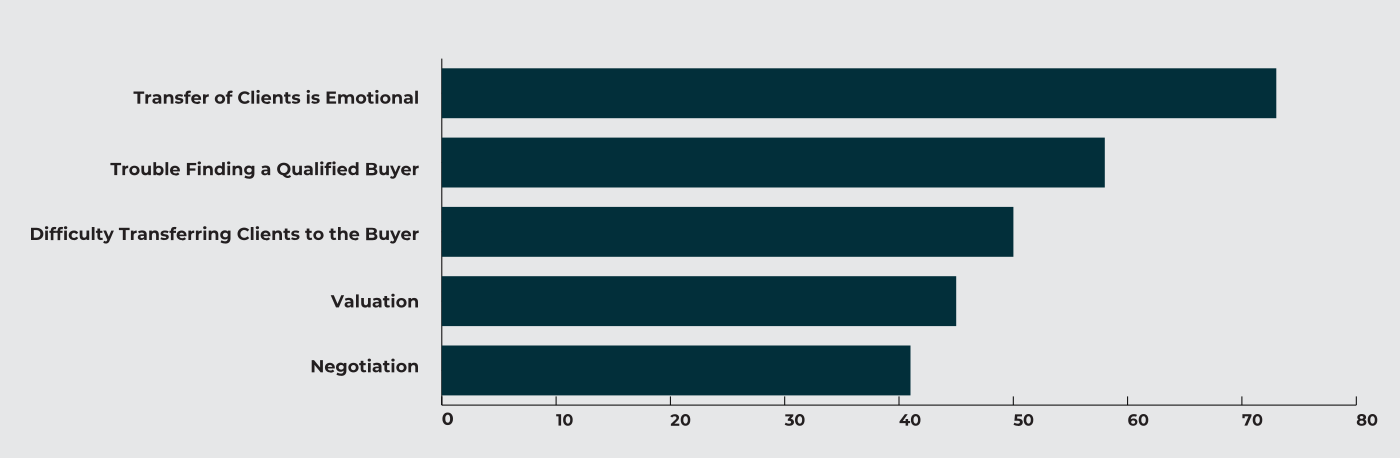
Why? In one Cerulli study, practice management professionals cited a bevy of obstacles, with the emotions of transferring clients topping the list.3
Top Challenges in Succession Planning
Common Concerns

How Cambridge Helps
As many advisors have experienced, managing everything that goes into succession planning while running a business can be difficult and exhausting. You don’t have to do this alone, and you shouldn’t. Joining a partner firm with the resources to help you build and execute a plan can save time, money, and headache. At Cambridge, our in-house Succession and Acquisition Solutions (SAS) Team can support you through every stage of your succession planning journey.
- Business Valuation — Market-based, risk-adjusted valuation analysis to determine fair market value based on geography, client demographics, and asset concentration
- Consulting — Personalized, one-on-one guidance through every stage of a practice acquisition, merger, or sale
- Customized Lending — Flexible financing solutions to fit your needs. Since inception, SAS has provided more than $50 million in financing to help advisors successfully complete transactions
Alternatively, if it’s the right fit for your objectives and vision, Cambridge can also serve as a direct buyer of your business.
The Cost of Doing Nothing
In the end, doing nothing is the riskiest move of all. By not establishing a succession plan before it’s too late, advisors put themselves in jeopardy of losing clients, watching the value of their business decrease, and having their business end up in the wrong hands.
The earlier you can start assembling the foundation of your succession plan, the better off you’ll be. The Financial Planning Association (FPA) recommends starting succession planning at least 5-10 years before retirement, and research from Pershing Advisor Solutions shows that advisors who have executed a succession plan typically manage to retain 80% or more of their clients.4
You Control the Journey
The time to begin your succession plan is now. Read our Six Steps to Succession Planning whitepaper to learn how to define your plan, value your business, and identify a successor that’s right for you.
1Bloomberg Staff. (2025). Inside the Financial Advisor Succession Crisis. Bloomberg.
2Kelly. G. (2025). Less Than Half of RIAs Have Succession Plans. The Daily Upside.
3Cerulli Associates. (2024). Assets in Motion: Financial Advisor Retirement. Cerulli Associates.
4Pershing. (n.d.). The Succession Challenge: What’s Your Gameplan? Pershing Advisor Solutions.
Our Why
Cambridge’s leadership team is dedicated to ensuring our long-term independence.
Find Stability in a Shifting Landscape
Hear from our CEO and Co-Chairman of the Board, Amy Webber, on why Cambridge has remained internally controlled for nearly 45 years1–and why we’re built to stay that way for the long haul.
Industry Consolidation: An Advisors’ Checklist for Navigating Common Pitfalls
The financial services industry continues to consolidate at a record pace. Our consolidation checklist will help you evaluate your partner firm and avoid getting swept up in the middle of an unwanted M&A deal.
Cambridge Investment Research, Inc.
1776 Pleasant Plain Road, Fairfield, IA 52556-8757
Business Development: 877.688.2369
Reception: 800.777.6080